In this guide
A seat on Switzerland’s famous Glacier Express costs about ₹20,000. And here’s the part nobody tells you: even if you already have a Swiss Travel Pass, you still have to pay around ₹5,000 for a compulsory seat reservation. But I did the exact same scenic route — the same mountains, the same passes, the same valleys — completely free, on normal regional trains. Here’s exactly how.
First — what is the Glacier Express?
It’s the most famous scenic train in Switzerland, running between Zermatt (below the Matterhorn) and St. Moritz. The full journey is 291 km over about 8 hours, climbing over the Oberalp Pass at 2,033 m, crossing 291 bridges and winding through the Rhine Gorge. It’s often called “the slowest express train in the world” — because the whole point is to go slow and stare out of the window. The train has big curved panoramic windows, a dining service and audio commentary.
It is beautiful. But it is not as free — or as cheap — as people think.
Why it costs money even with the Swiss Travel Pass
| How you ride the route | You actually pay | What you get |
|---|---|---|
| Glacier Express — no pass | ~CHF 208 (~₹20,000) | CHF 159 fare + CHF 49 seat reservation, panoramic windows, dining |
| Glacier Express — with Swiss Travel Pass | ~CHF 49–54 (~₹5,000) | Fare is covered, but the seat reservation is still compulsory |
| Regional trains — with Swiss Travel Pass | ₹0 — free | Same tracks, same views, no reservation, hop on and off |
So the Swiss Travel Pass covers the fare, but the Glacier Express forces a mandatory seat reservation (about CHF 49, going up to CHF 54 from December 2025) that you pay on top. That’s the ~₹5,000 that surprises everyone.
The hack: regional trains run the exact same tracks
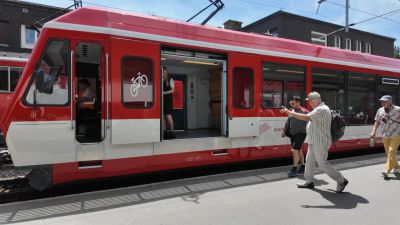
Here's the secret: the same route the Glacier Express takes is also run by ordinary regional trains (the red Matterhorn Gotthard Bahn and Rhaetian Railway trains). They go on the exact same tracks, through the exact same mountains — and they are completely free with the Swiss Travel Pass, with no seat reservation at all. They run every hour, all year round, so you just walk up and hop on. I did this myself, and honestly, I couldn't feel much difference between the two trains — you'll see for yourself when you go.
The route, stop by stop
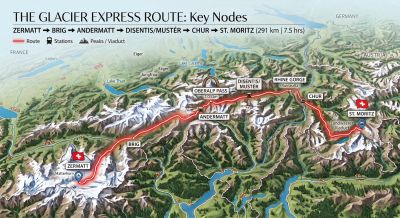
To do the whole thing on regional trains, you change trains a few times — roughly at Visp/Brig → Andermatt → Disentis/Mustér → Chur — and it takes about the same 8 hours as the Glacier Express. The big advantage: because the regional trains stop everywhere and run hourly, you can hop off at any town, explore, and catch the next one — something the one-a-day Glacier Express can’t do.
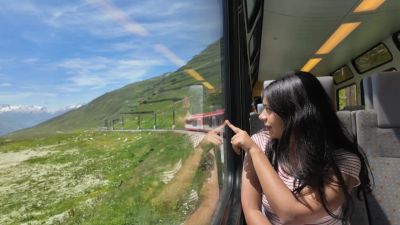
The scenery is the real reason people take this train, and on the regional route you get all of it — the climb over the Oberalp Pass, the deep river gorges, the little wooden villages and the snow peaks. The only thing you miss is the Glacier Express's curved "panoramic" roof windows. On a regional train you have big normal windows instead — which you can actually open to get a clean photo without glass glare.
What the regional train is actually like
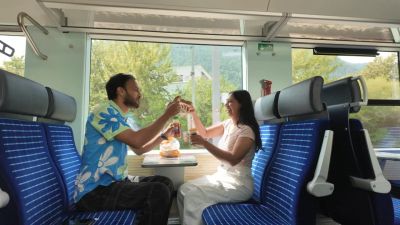
Don't imagine a crowded local train — these are clean, comfortable trains with big windows and fold-down tables. The one thing they don't have is a dining service, so I did what I always do to save money: I packed my own snacks and sandwiches from a supermarket and had a little picnic on the way. Honestly, eating my own food while watching the Alps roll by was one of my favourite parts. (See my budget food in Switzerland guide for exactly what I pack.)
How I did it — a taste of the route
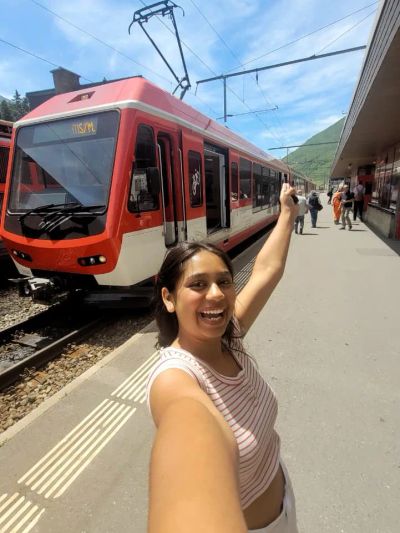
You don't have to do all 8 hours in one go. I did a 2.5-hour stretch of the route to Andermatt, which is a perfect taste of the journey if you're short on time — you still climb through the best mountain scenery. There was no booking, no queue and no fee: I just checked the departure, walked to the platform, and got on with my Swiss Travel Pass. That's the whole magic of it.
Hop off at Andermatt (and walk to the Devil’s Bridge)
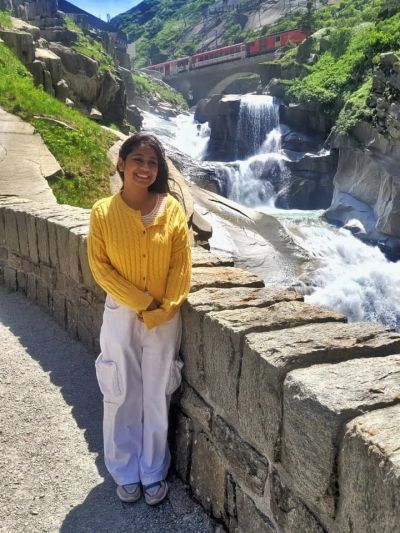
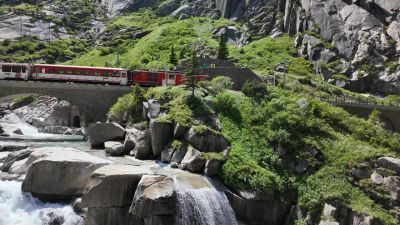
This is the best reason to take the regional trains: you can get off and explore. Andermatt is a lovely stop — from the station it's a short, thrilling walk into the Schöllenen Gorge to the legendary Devil's Bridge, with a rushing waterfall right below. The Glacier Express just rolls past all of this. I wrote a full Andermatt & Devil's Bridge guide with the exact walk and train times.
So — is the Glacier Express worth paying for?
Here’s my honest take. The Glacier Express is a beautiful, comfortable, bucket-list experience, and if the panoramic windows, the sit-down meal and the “I rode the famous train” feeling matter to you, go for it. But you are paying about ₹5,000 (with a pass) or ₹20,000 (without one) for the same scenery you can see for free on the regional trains — plus the regional route lets you stop and explore along the way. For a budget trip, the regional trains win every single time.
This is the same money-saving idea I use across my whole Switzerland trip — see my 7-day Switzerland itinerary and what’s 100% free with the Swiss Travel Pass.
Watch how I did it
Frequently Asked Questions
Is the Glacier Express free with the Swiss Travel Pass?
Do the regional trains have the same views as the Glacier Express?
How long is the route on regional trains, and how many changes?
Do I need to book the regional trains in advance?
Glacier Express or regional trains — which should I pick?
Have a question about this trip?
Got a question I haven't covered in the guide above? Drop it below — I personally read every one and often add the best questions into the FAQ section of this guide.
You'll share your name and email so I can reply. I use them only to answer you — see our Privacy Policy.